BEFORE THE SIGNS
Words and counters
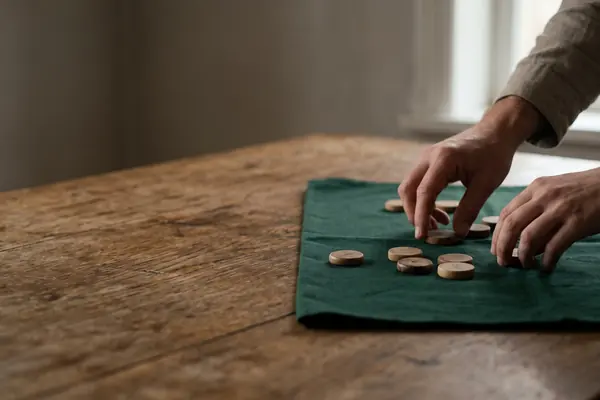
Before symbols, printed books wrote equality as a word, such as aequales or gleich. Recorde's own arithmetic taught working with counters.
Pick a sign doodleplus™
WHAT THE HISTORY SAYS
The signs are younger than the sums.
1489 + and − in print
1489 First printed + and − signs
People added and subtracted for thousands of years using words. The + and − signs only reached print in 1489, and the equals sign followed in 1557, thanks to a doctor from Tenby.
THE SHORT ANSWER
Each sign began as a way to save writing a word.
Some took a century or more to catch on.
BEFORE THE SIGNS
Before symbols, printed books wrote equality as a word, such as aequales or gleich. Recorde's own arithmetic taught working with counters.
Pick a signPLUS AND MINUS
In 1489 Johannes Widman used + and − for surpluses and deficits in business sums. The signs were also painted on barrels to show whether they were full.
See the datesEQUALS
Robert Recorde, born in Tenby, chose a pair of parallel lines in 1557 “bicause noe 2 thynges can be moare equalle”.
Meet RecordeA QUICK SIGN CHECK
Pick a sign from a calculator keypad to see when it first appeared in print and who used it. The bar shows how long the sign has been in print.
Dates from the MacTutor History of Mathematics, University of St Andrews.
FOUR THINGS TO TRY
Each of these turns an ordinary sum into a small piece of history. They work at the kitchen table or in a classroom.

Say 5 + 7 as “five and seven”. Historians think the plus sign began as a quick way of writing the Latin et, meaning and.
Recorde drew his equals sign much longer than ours. Try a long pair of twin lines and see why he thought nothing could be more equal.
Write a sum without any signs at all, the way books did before 1489. It quickly shows why shorthand caught on.
Leibniz preferred a dot for multiplying because × is easily confused with the letter x. Look for the dot in algebra books.
TWO DATES WORTH KNOWING
One date for the first printed plus,
one gap that shows how slowly equals spread.
1489
First printed + and − signs
Johannes Widman's book of mercantile arithmetic, printed in Leipzig, used them for excess and shortfall, as in “4 centner + 5 pfund”.
PLUS AND MINUS · MACTUTOR
61 years
Years before = was printed again
After Recorde's book of 1557, the equals sign next appeared in print in 1618. Words such as aequales and the abbreviation aeq stayed in use.
EQUALS · MACTUTOR
MacTutor notes the + and − signs only came into general use in England after Recorde used them in The Whetstone of Witte in 1557.
MEET ROBERT RECORDE
Recorde was a Welsh doctor and mathematician who studied at Oxford and Cambridge and later ran the Bristol mint. He wrote his textbooks in English, not Latin, so that anyone could learn.
His algebra book's title, The Whetstone of Witte, is a pun: cos is Latin for whetstone, and algebra was once called the cossic art. It was a book for sharpening your wits. He died in 1558.

Questions
Nobody can be named for certain. A sign like + was used as shorthand for the Latin et (and) in manuscripts, and Johannes Widman was the first to print + and − in 1489.
Robert Recorde, a Welsh doctor and mathematician, in The Whetstone of Witte (1557). He used a pair of parallel lines because no two things could be more equal.
The × sign appears in an anonymous appendix of 1618 believed to be by William Oughtred, who used it in Clavis Mathematicae, published in London in 1631.
Johann Rahn first used ÷ for division in Teutsche Algebra in 1659. Before that, many writers had used the same mark as a minus sign.
No. It next appeared in print in 1618, and other marks such as || and ae, from the Latin aequalis, were widely used into the 1700s.
Updated
ABOUT THIS NAME
doodleplus.com is part of the DoodleSale portfolio. It isn't in an auction right now, but you can ask about leasing it.